


Intro
What does an anti-reverse MOSFET do?
- Block reverse current (primary function)
When the power polarity is connected incorrectly, or the battery voltage drops lower than the bus voltage, current will try to flow backward into the power source. The anti-reverse MOS cuts off this reverse path instantly, protecting batteries, MCU and other front-end components from reverse polarity damage.
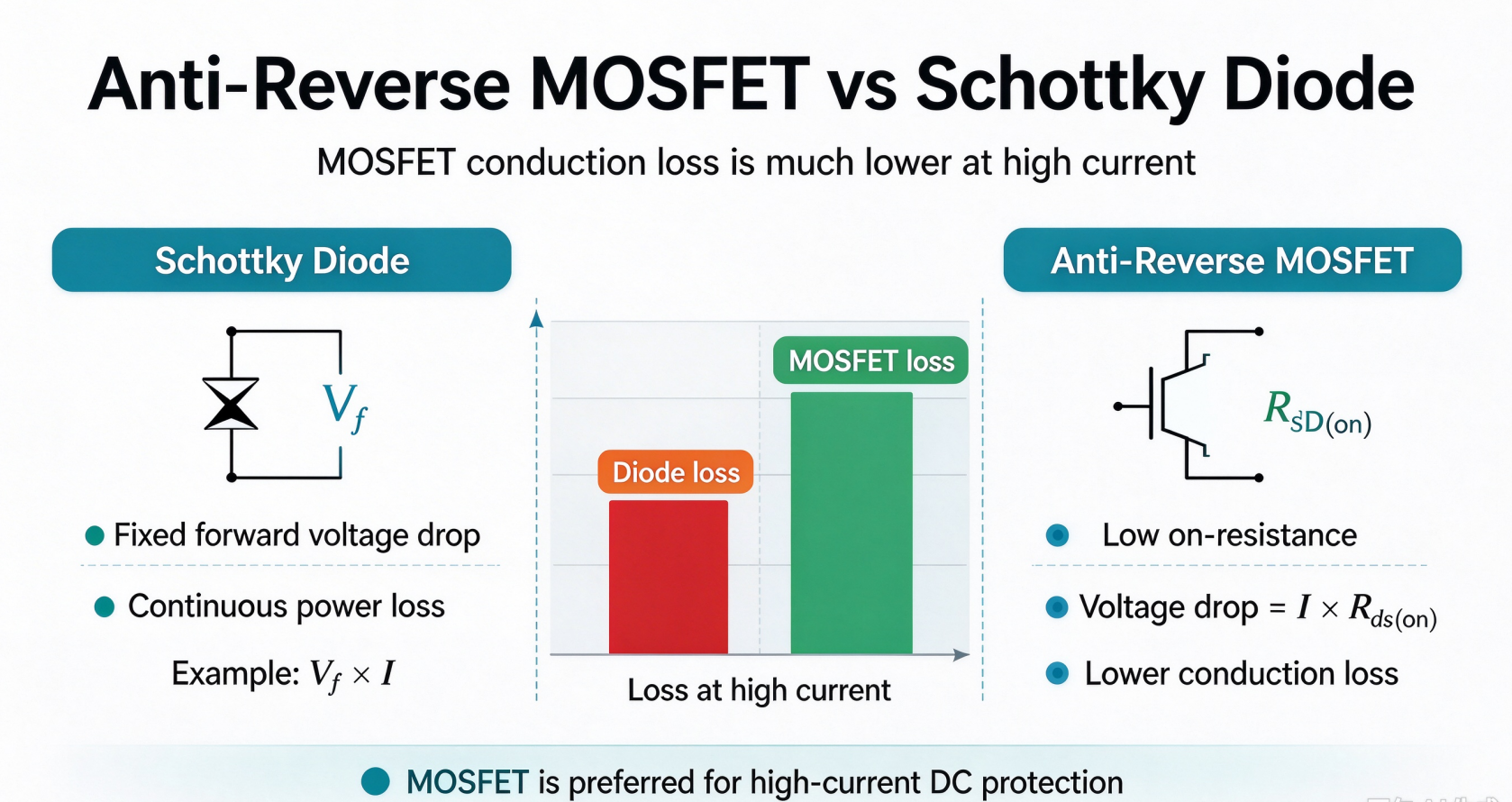
Unlike ordinary diode anti-reverse protection, MOSFET has ultra-low on-resistance, so conduction power loss is far smaller.
-
Suppress reverse inrush / back EMF impact
In inductive loads such as motors and solenoids, the inductor will generate high back electromotive force when switching off. The anti-reverse MOS acts as a barrier to prevent this reverse voltage spike from rushing back to the main power rail, avoiding overvoltage breakdown of sensitive circuits.
-
Isolate power rail during fault state
When the main circuit fails, the anti-reverse MOS can turn off to physically isolate the battery side from the load side. It stops fault current from pouring back to the battery pack and prevents secondary damage.
-
Reduce power loss compared with diode protection
Schottky diodes have a fixed forward voltage drop, causing continuous heat generation under high current. Anti-reverse MOSFET works in ohmic region after turn-on. The voltage drop equals I×Rds(on). For high-current systems, heat dissipation and efficiency are greatly improved.
Typical Application Scenarios
- Lithium battery packs for portable devices
- BLDC motor controllers
- Solar power input terminals
- 12V/24V industrial DC power equipment
- Automotive low-voltage auxiliary power circuits
Key Design Notes
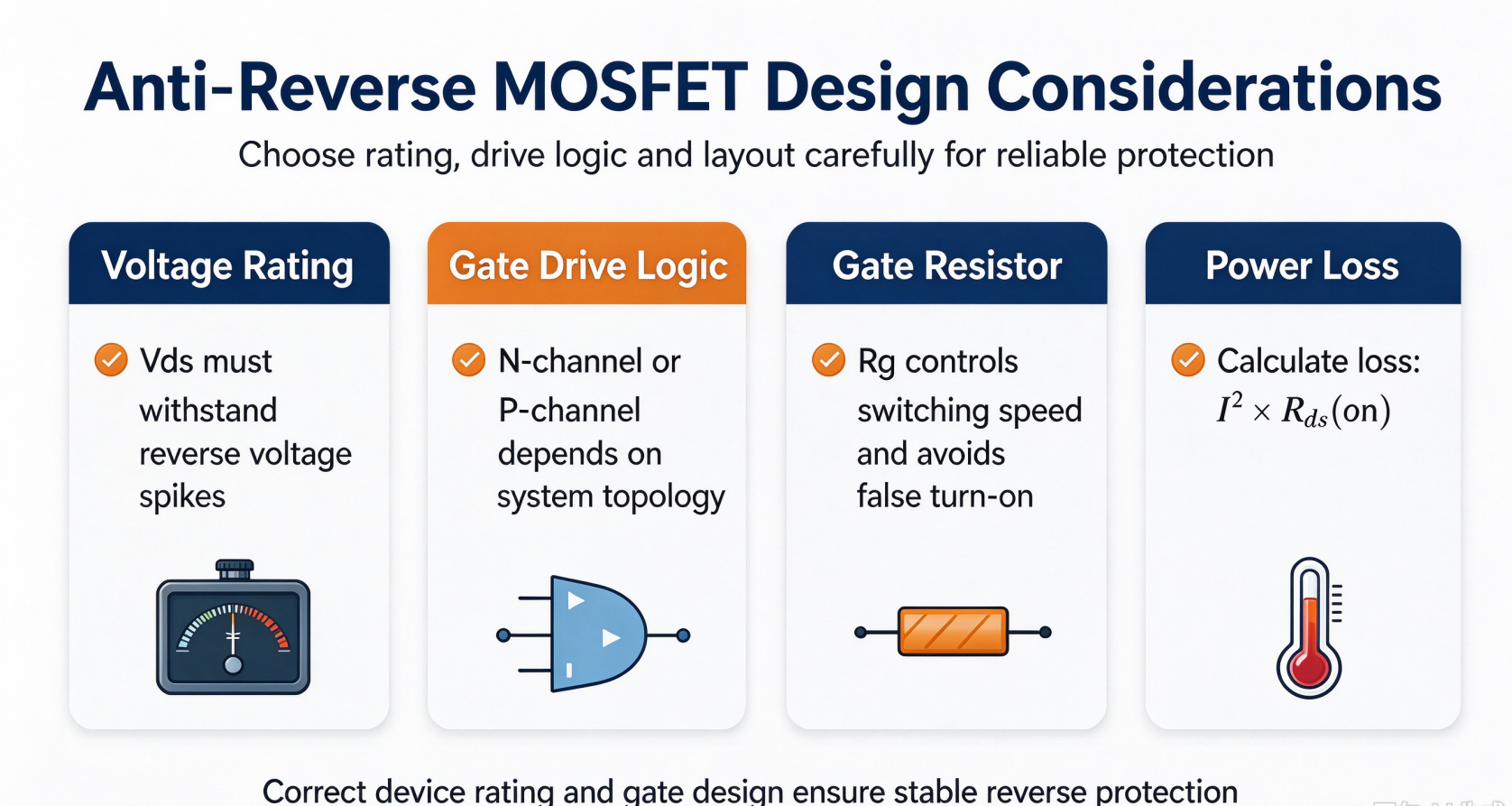
- Select MOS with proper Vds rating to withstand reverse voltage spike
- Pay attention to gate driving logic: N-channel or P-channel configuration
- Match gate resistor to avoid false turn-on caused by noise
- Calculate power consumption based on working current and Rds(on)
Conclusion


-

MOSFET Anti-Reverse Circuit
-

What do the three pins G, S, and D of the packa...
-

The Complete Guide to MOSFET Amplifiers: From B...
-

High Voltage Gate Drivers: Powering Next-Genera...
-

MOSFET Failure Analysis: Understanding, Prevent...
-
Small Package MOSFETs
-

MOSFET as Ideal Diode: Revolutionary Approach t...
-

Wiring a MOSFET for Your Nerf Blaster: Professi...
-

What is Darlington Emitter Follower? A Comprehe...
-

New MOSFET Sourcing Choice: WINSOK Domestic Sub...
-

How to determine the high-power MOSFET is burne...
-

VE MOSFET Technology: Revolutionizing Power Ele...
-
MOSFET original basic knowledge and application
-

The Versatile 2N7000 Transistor: A Comprehensiv...
-

Discrete MOSFETs: Powering Tomorrow’s Ele...
-

MOSFET 101: The Ultimate Beginner’s Guide...


