


Introduction
P‑channel or N‑channel MOSFET is widely used for power‑supply reverse‑polarity protection. The gate resistor (Rg) is a simple yet critical component. Many designers pick a large resistor for safety, but oversized Rg brings several hidden reliability risks.
1. Extremely Slow Turn‑on & Turn‑off Speed
Gate resistor limits the charging and discharging current of MOSFET gate‑source capacitance Cgs.
- Too large Rg reduces gate charging current. MOS takes much longer time to cross the Miller plateau region.
- For reverse‑protection circuit: When power is plugged in, MOS turns on very slowly.
- Consequence: The MOS stays in linear (ohmic) region for a long time. High power dissipation occurs during transition. The device may get hot or suffer thermal damage especially under high load current.
2. Weak Response to Transient Reverse Voltage Spike
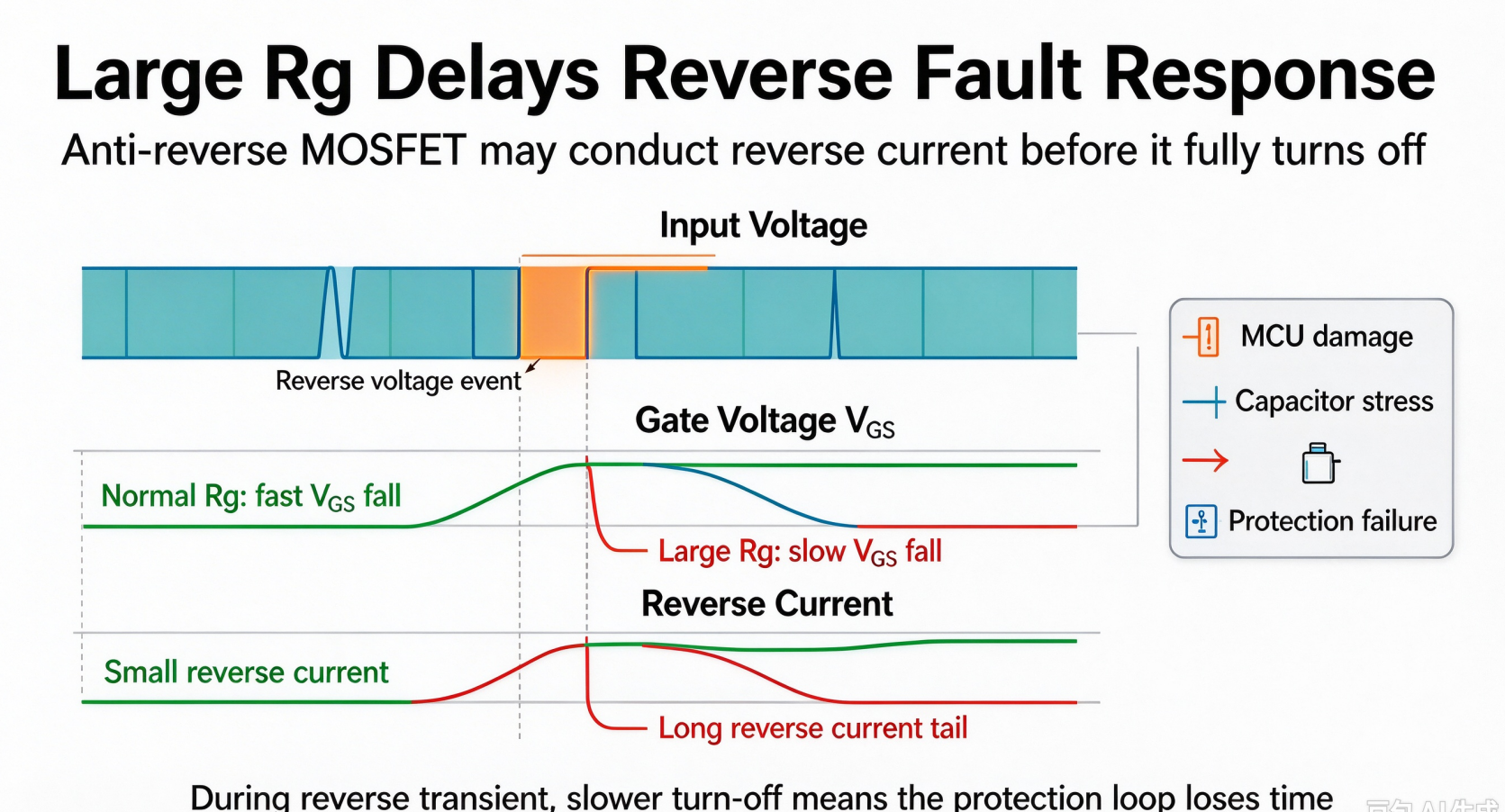
When input voltage reverses abruptly (hot‑plug, battery swap, wiring fault), anti‑reverse MOS needs to turn off quickly to block reverse current.
- Large Rg slows down gate discharge. MOS cannot shut down instantly.
- Reverse current can flow through MOS channel for hundreds of nanoseconds to microseconds.
- Result: Back‑feed reverse current may damage downstream circuits, capacitors or MCU. The anti‑protection function loses effectiveness in fast transient events.
3. Susceptible to Gate Noise and False Trigger
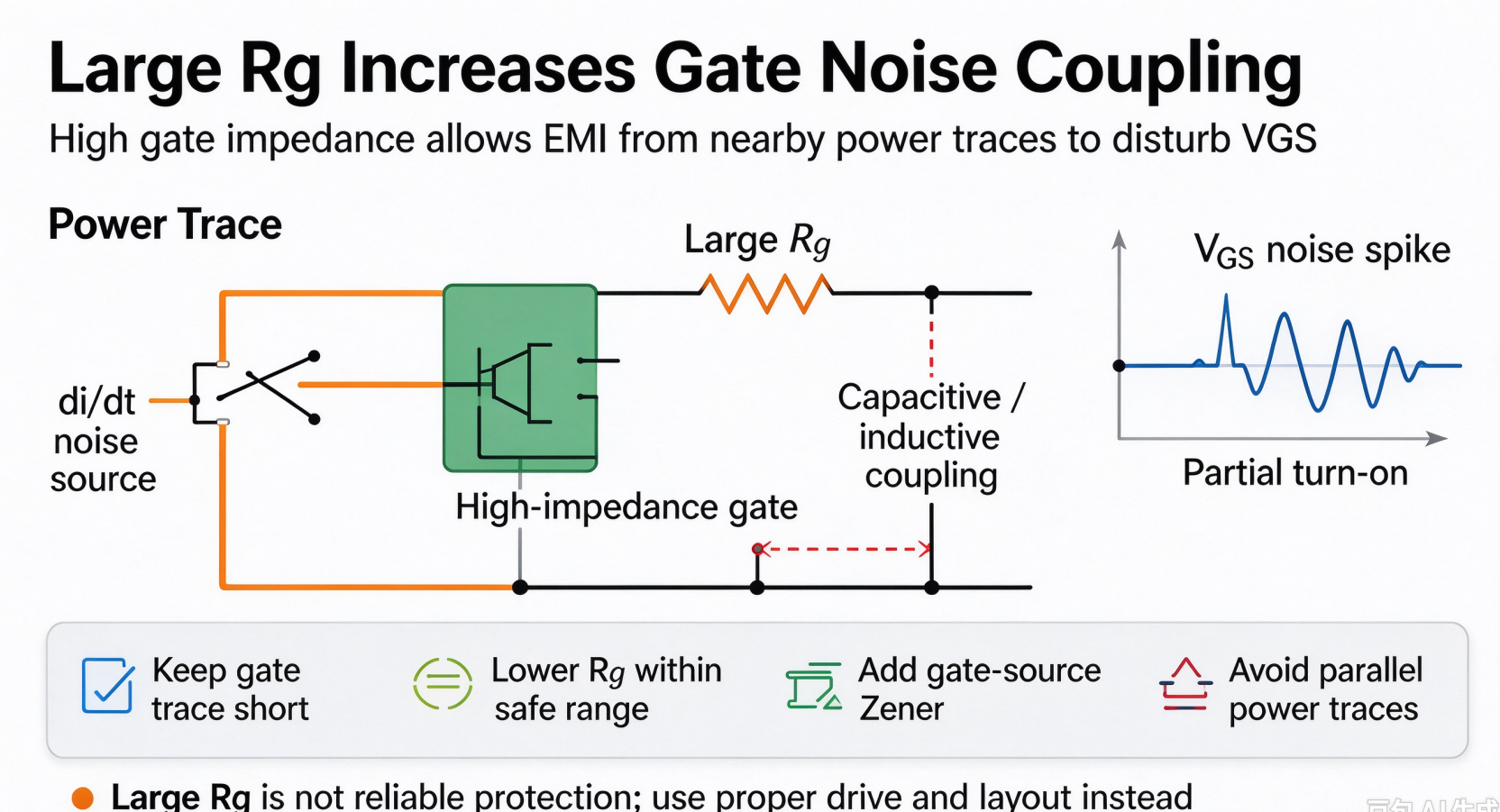
High‑value gate resistor increases gate impedance. The gate node becomes high‑impedance node, vulnerable to coupled EMI noise from power traces.
- Stray coupling noise can induce unwanted gate voltage fluctuation.
- May cause partial turn‑on: MOS works in linear region continuously, generating extra heating.
- In severe cases, intermittent oscillation or spurious switching appears.
4. Trade‑off note: Why do engineers use larger Rg sometimes?
Moderate Rg suppresses gate ringing and EMI. But there is an upper limit.
For typical battery anti‑reverse P‑MOS:
✅ Recommended range: 1 kΩ ~10 kΩ
⚠️ Avoid: > 22 kΩ for heavy‑load reverse‑protection applications.
If Rg is above 50 kΩ, all above risks become prominent.
5. Design Remedy
- Keep gate resistor within recommended range; do not arbitrarily increase Rg for “more safety”.
- Add gate‑source Zener diode for over‑voltage protection, do not rely only on large Rg.
- Short, low‑impedance routing for gate trace to minimize stray coupling.
- Perform hot‑plug and reverse‑polarity test under maximum load to verify real‑world performance.
Summary
Oversized gate resistor for anti‑reverse MOSFET leads to slow switching speed, high transient power loss, delayed reverse‑fault response and EMI‑induced false switching. Safety cannot be achieved by simply increasing gate resistance. Always balance switching speed, thermal performance and noise immunity.


-

MOSFET Gate, Drain, and Source: Core Principles...
-

MOSFET Variable Resistors: Engineering Solution...
-

Causes and Prevention of MOSFET Failure
-

Working principle of N-channel enhancement mode...
-

Do You Know About MOSFET Circuits?
-
How to choose the right package MOSFET?
-

Differences Between Depletion-Mode MOSFETs and ...
-

How to select the most suitable driver circuit ...
-

What Is MCU in Electronics: The Brain Behind Sm...
-

CMS8H1213 MCU Cmsemicon® Package SSOP24 Batch 24+
-

Lithium battery charging is easy to damage, WIN...
-

Understanding MOSFET: The Cornerstone of Modern...
-

Building a MOSFET H-Bridge: Essential Guide for...
-

Fast Switching MOSFETs: The Complete Guide to N...
-

Do you know the three poles of MOSFET?
-

What do the three pins G, S, and D of the packa...


