


1. Over‑charge protection
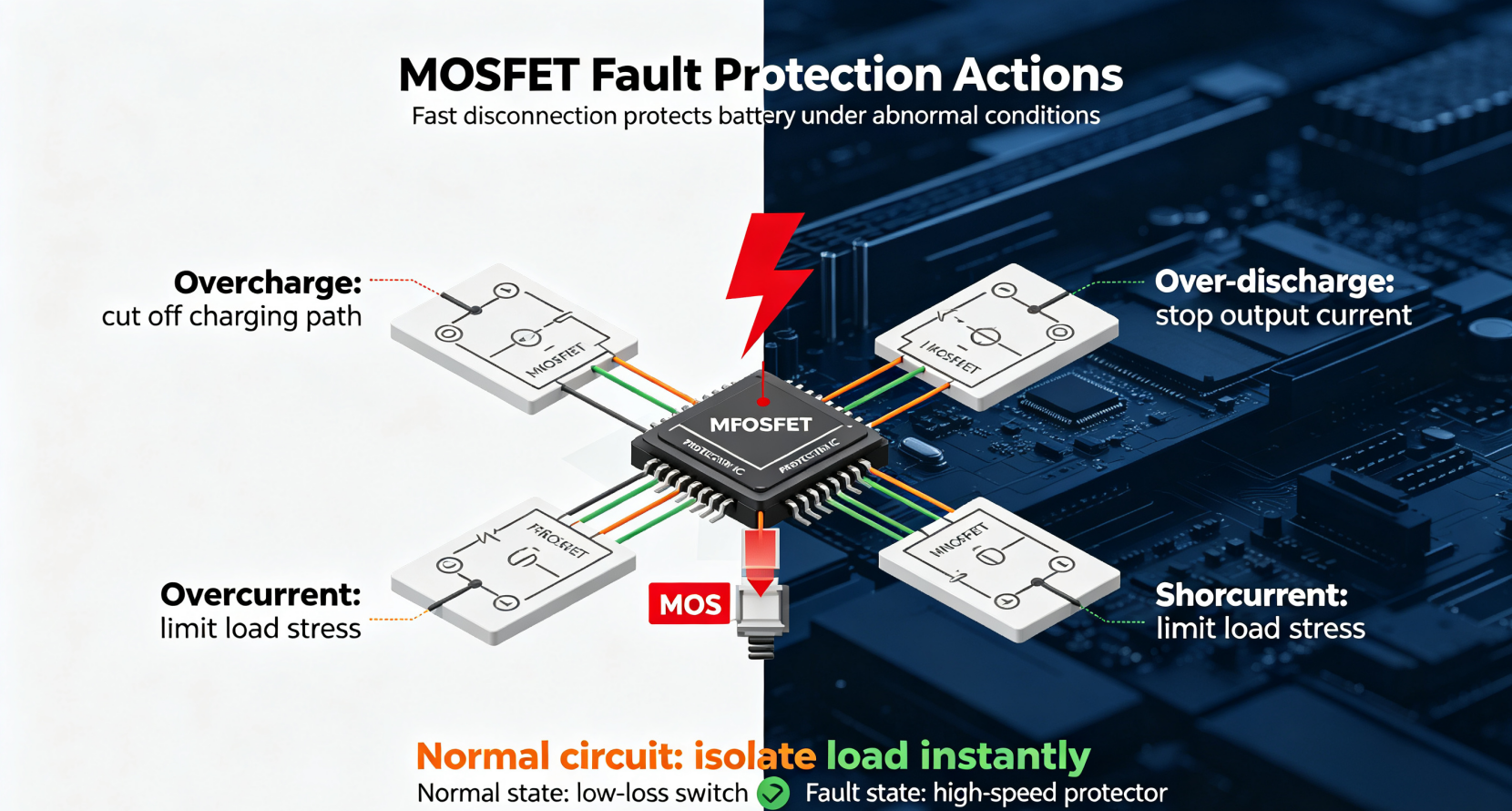
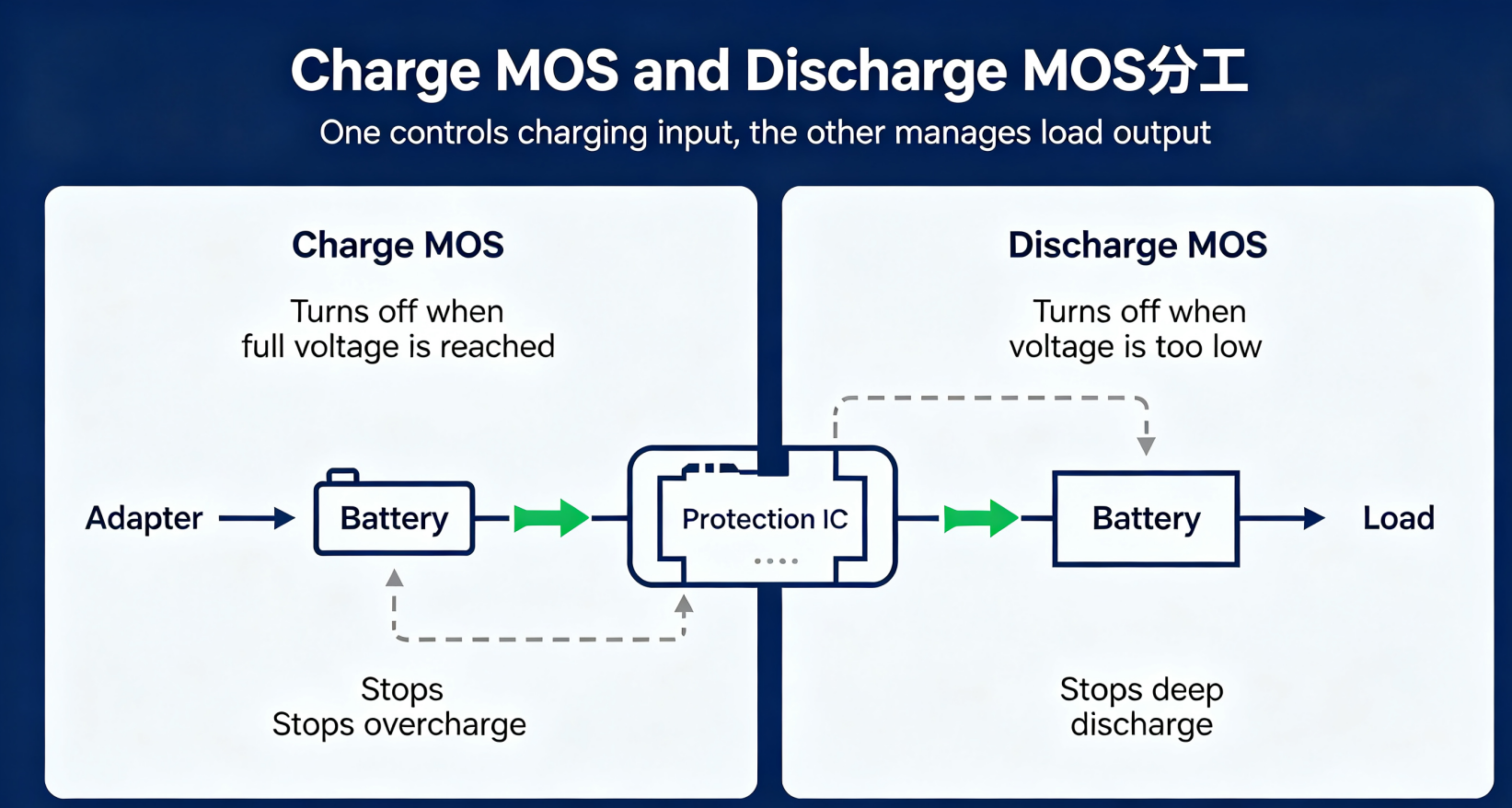
The charging path is physically disconnected, and external power cannot continue to charge the battery. This prevents risks such as battery swelling, thermal runaway caused by over‑charging. The discharge MOS remains on, and the battery can still supply power normally to the load.
2. Over‑discharge protection
The discharge loop is cut off, and the battery stops outputting current outward. It avoids permanent capacity attenuation or cell damage triggered by deep over‑discharge. At this time, the charge MOS is ready, and normal charging can resume once an adapter is connected.
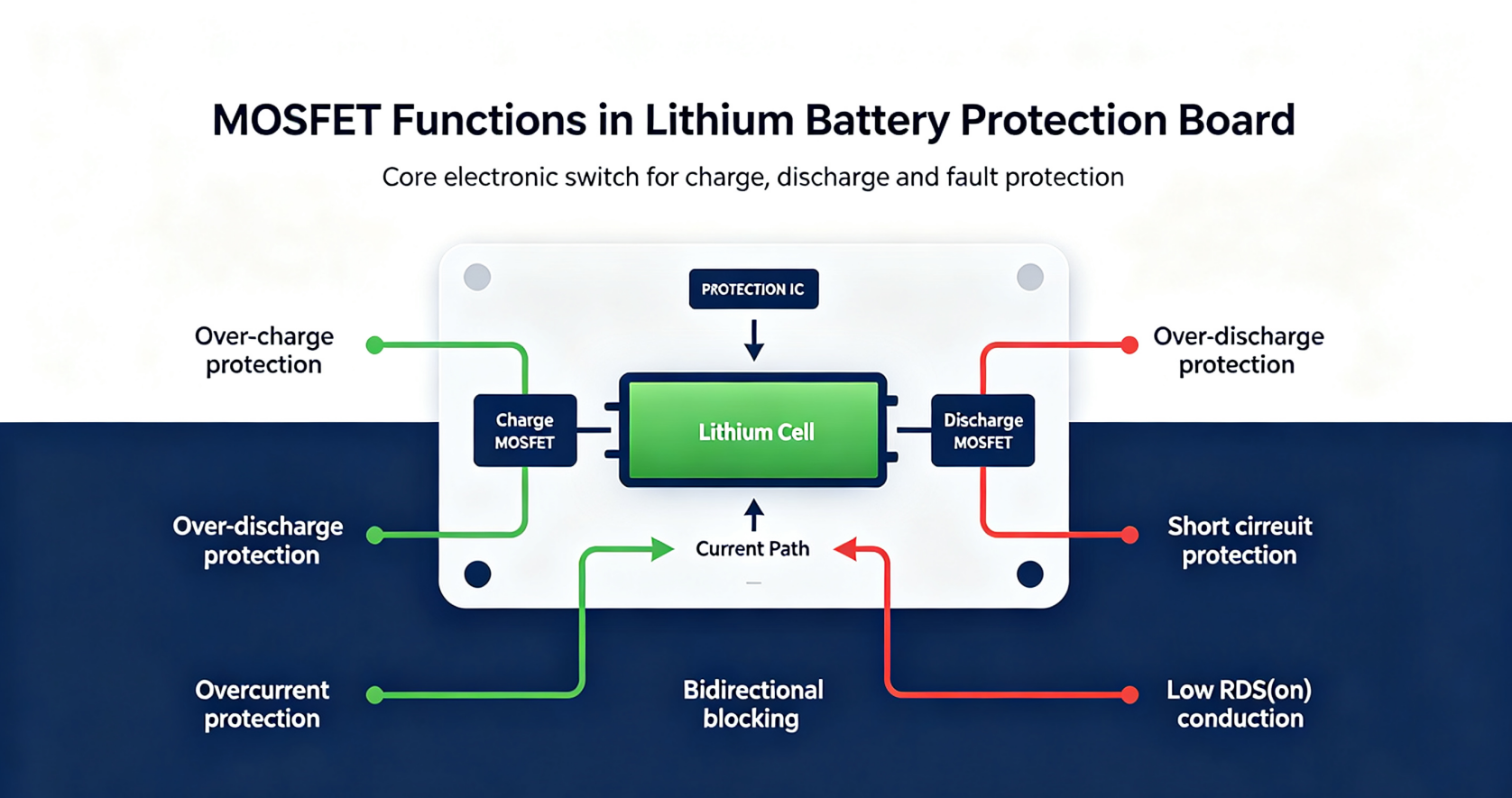
3. Over‑current & short‑circuit protection
It isolates the battery from the short‑circuit load, avoids excessive heat generation, smoking or even fire hazards brought by large short‑circuit current.
4. Charge over‑current protection
It limits excessive charging current, inhibits lithium dendrite precipitation inside lithium‑ion cells, and extends battery service life.
5. Bidirectional blocking (eliminate body‑diode risk)
When both MOS are off, neither charging direction nor discharging direction can conduct through body diodes. It prevents unwanted reverse leakage, and realizes true bidirectional cut‑off, which single MOS cannot achieve.
6. Low‑resistance conduction under normal working status
Battery energy can flow in or out efficiently without large power waste.
Summary
- Charge MOS mainly manages the input of charging current, responsible for over‑charge and charging over‑current protection.
- Discharge MOS mainly controls output of load current, responsible for over‑discharge, discharge over‑current and short‑circuit protection.
- Under normal conditions, MOS acts as a low‑loss conductor; under fault conditions, it acts as a high‑speed electronic switch to disconnect the circuit for battery safety.


-
Enabling High Power Applications: Winsok Mosfet...
-

DIY MOSFET RF Amplifier Design: A Comprehensive...
-

Leading Companies in FET/MOSFET Technology Worl...
-

Understanding MOSFET’s Capacitive Propert...
-

How to Judge MOSFET Working State According to ...
-

Comprehensive Guide: Driving MOSFETs with Optoc...
-

What Are the Advantages of Power MOSFETs?
-

Parameter analysis and measurement of MOSFETs
-
Application of MOSFET in the drive circuit of D...
-
MOSFET original basic knowledge and application
-

Which Companies Lead in FET / MOSFET Technology?
-

Understanding the function and structure of MOS...
-

RDS(on) in MOSFETs: The Critical Parameter for ...
-

Small Signal Model MOSFET Analysis and Implemen...
-

High Voltage Gate Drivers: Advancing Power Elec...
-

Do you know what an N-channel MOSFET is?


