


1. Overview
MOSFETs are core control components inside antenna RF front-end circuits, widely used in mobile phones, BLDC remote control, WiFi, Bluetooth, RFID, 5G base station and wireless sensor equipment.
They are mainly divided into RF small-signal MOS (for signal switching/tuning) and power MOSFET (for transmitting power drive). This article sorts out 6 mainstream application functions.
2. Main Function 1: RF Signal Switch / Transmit-Receive Switch (Most Common)
Core Principle
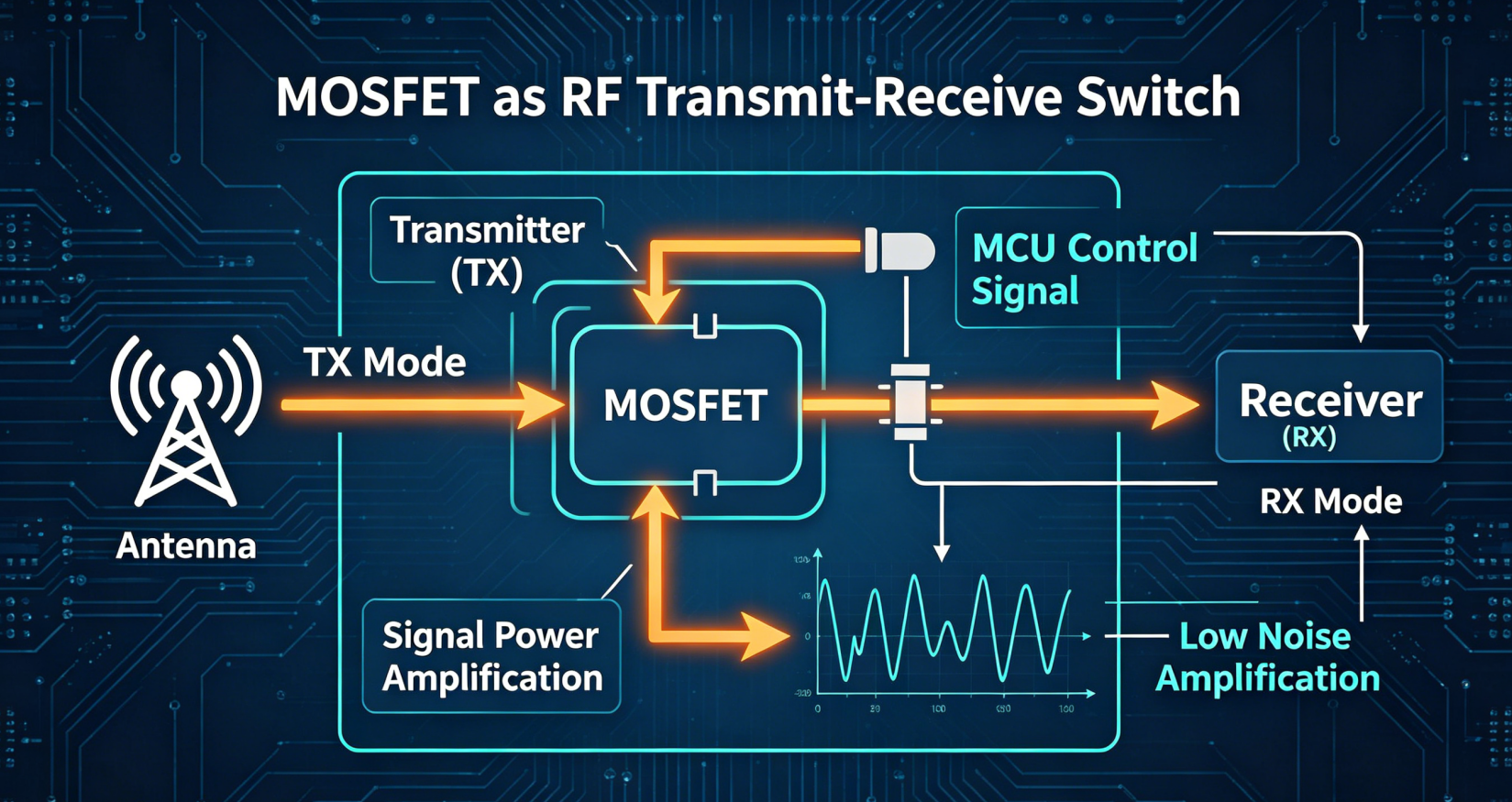
Use the gate voltage to control MOS turn-on & cut-off, switch the signal path between antenna, transmitter (TX) and receiver (RX).
- Time division communication (Bluetooth/WiFi/remote control):
- MOS ON: Antenna connects to transmit circuit, send RF signal out
- MOS OFF: Antenna links to receiving circuit, capture external signal
- Multi-band antenna switching (4G/5G smartphone):
Multiple MOS branches independently control different frequency antennas, switch 2G/3G/4G/5G bands in nanoseconds without mechanical relays.
Key Advantage
Ultra-fast switching speed (1–10ns), low insertion loss, high isolation between channels to avoid signal crosstalk.


MOS RF transmit-receive switch circuit diagram
3. Main Function 2: Antenna Impedance Tuning & Reconfigurable Matching
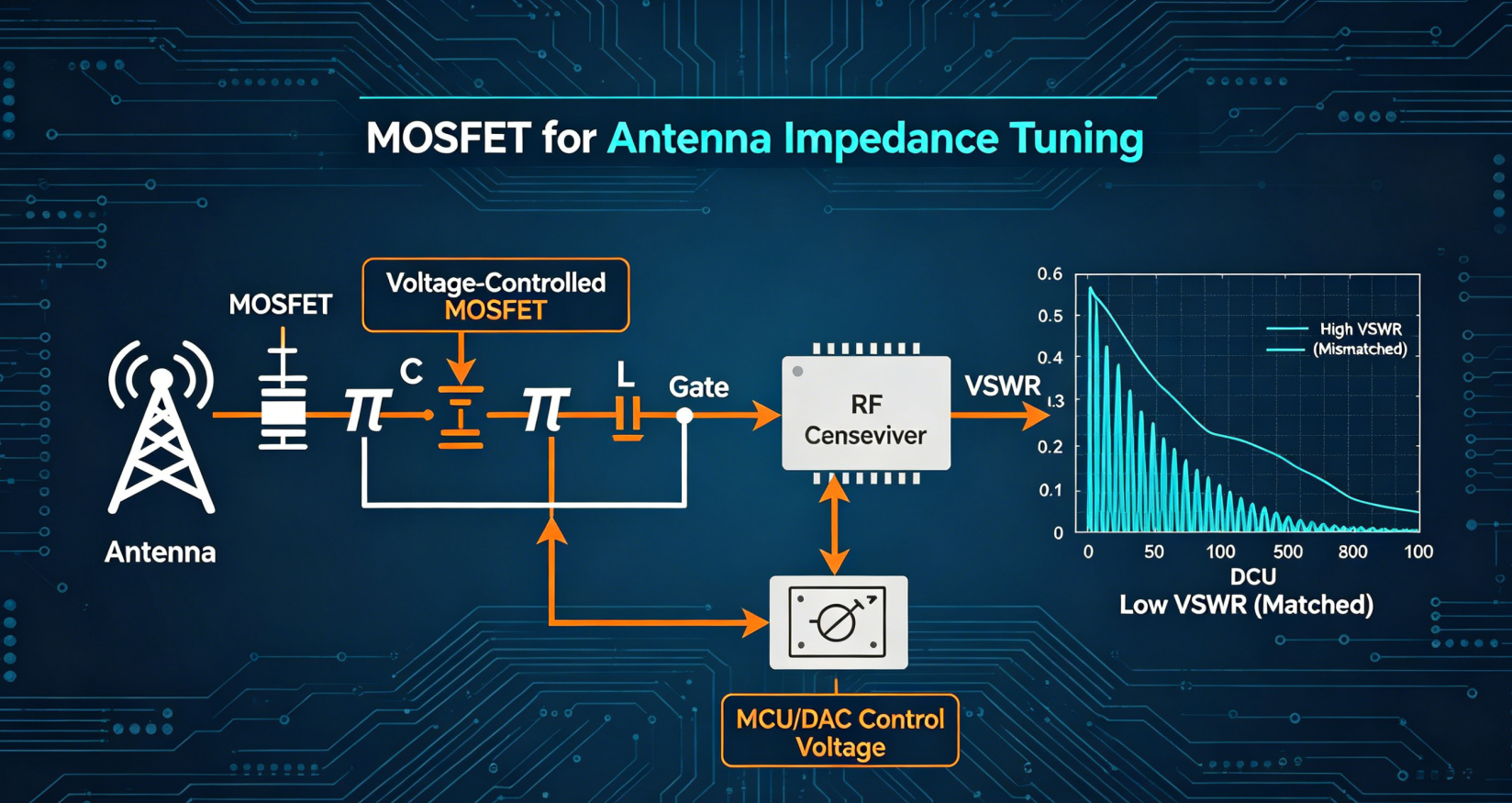
Antennas only work efficiently at fixed impedance (standard 50Ω). Metal housing, distance change will mismatch impedance and weaken signal.
- MOSFET works as voltage-controlled variable resistor in linear region;
- MCU adjusts gate voltage to change equivalent resistance, cooperate with LC network to dynamically match antenna impedance;
- Widely used in foldable phones, wearable devices, BLDC remote controllers to stabilize communication distance
4. Main Function 3: RF Power Amplifier (Transmit Signal Boost)
LDMOS high-frequency power MOS is the core of antenna transmitting power amplifier:
- Amplify weak modulation signal from MCU to enough power for antenna radiation;
- Used in remote control transmitters, walkie-talkies, 5G base station antennas;
- Our Winsok power MOS with low Qg and low Coss features low switching loss for RF emission circuits.
5. Main Function 4: Antenna Drive Switch for LC Resonance Antennas (RFID / 13.56M Card Reader)
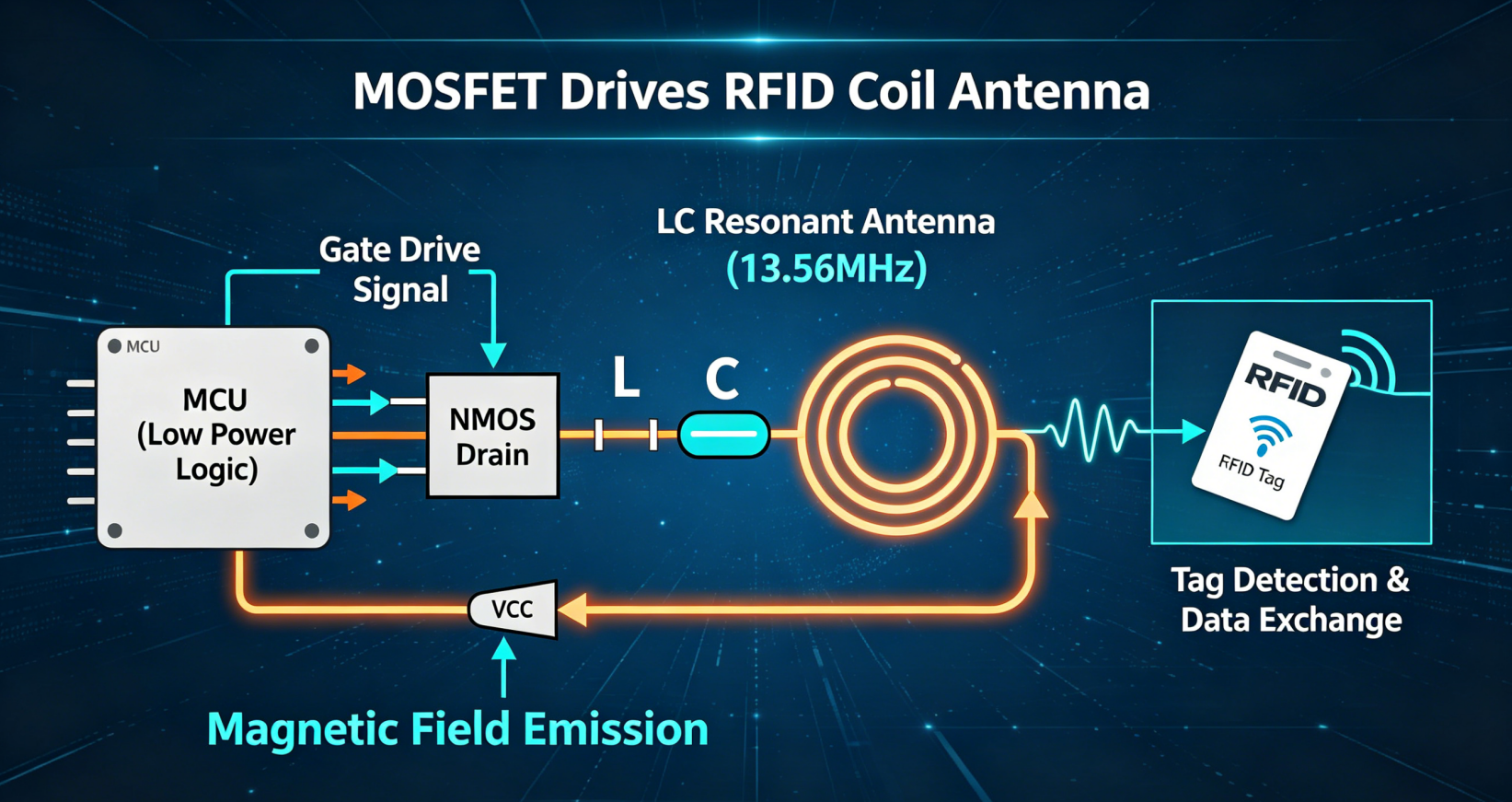
Low-frequency RFID, access control card readers adopt coil resonance antennas:
- MCU only outputs tiny logic signal, cannot drive large antenna coil current directly;
- NMOS/PMOS acts as power switch to turn on/off resonance antenna loop, control magnetic field emission;
- Low RDS(on) MOS reduces heating and improves reading distance of card readersTexas Inst….

RFID antenna circuit with MOS driver
6. Main Function 5: MIMO Array Beam Switching (5G Massive MIMO Base Station)
Base station massive MIMO contains hundreds of antenna units:
- Each antenna branch is equipped with independent MOS switch;
- System turns on partial MOS groups to activate specific antenna arrays, realize beam steering, concentrate signal to target equipment, enhance coverage and reduce interference.
7. Main Function 6: Antenna Short-Circuit Protection & Monitoring
MOS cooperates with comparator to build antenna detection circuit:
- When antenna shorted or disconnected, MOS cuts off RF power instantly to protect rear-end amplifier chip from burnout;
- Feed antenna fault signal back to MCU for alarm prompt.
8. Practical Selection Tips for RF Antenna MOS
- Small-signal antenna switch: Choose RF dedicated MOS with ultra-small parasitic capacitance Ciss/Crss to avoid signal attenuation;
- Transmit power amplifier / coil antenna drive: Select Winsok low RDS(on) power MOS to lower heat loss;
- Antenna impedance tuning: Prefer MOS with flat Vth tolerance, stable equivalent resistance under different gate voltages.
9. Summary
- Most common use: TX/RX switching & multi-band antenna path selection;
- Signal enhancement: RF power amplification for long-distance transmission;
- Signal optimization: Dynamic impedance matching to fix weak signal issue;
- Low-frequency wireless: Drive LC resonance antenna coils for RFID/remote control;
- 5G base station: MIMO array beam control and antenna fault protection.


-

A Comprehensive Guide: How to Add and Simulate ...
-

MOSFET Voltage-Controlled Resistor: Advanced Ap...
-

Technology Trends in the MOSFET Market – with W...
-

Power MOSFET V-I Characteristics: Analysis and ...
-
Small Package MOSFETs
-

The Complete Guide to MOSFET Amplifiers: From B...
-
What is the principle of the drive circuit of a...
-

Do you know the definition of MOSFET?
-

MOSFET Solid State Relays: Revolutionizing Mode...
-

Building OR Gates Using MOSFETs: A Practical Im...
-

Which Companies Lead in FET / MOSFET Technology?
-

Building a MOSFET H-Bridge: Essential Guide for...
-

How much do you know about MOSFET parameters? O...
-

Leading Companies in FET/MOSFET Technology Worl...
-

Testing MOSFETs with a Multimeter: Essential St...
-

What Is Pinch-Off Voltage in MOSFETs? Key Conce...


