


1. Definition of Anti-Reverse MOS
Anti-reverse MOS is a power MOS arranged in the charging input path, mainly to block reverse current when the adapter is plugged reversely, or when battery voltage surges back to damage the charging chip. It is often configured as back-to-back NMOS or independent high-side PMOS on charging circuits. Once this component breaks down, the whole charging system faces multiple severe failures.
2. Direct Damage to Front-End Charging IC
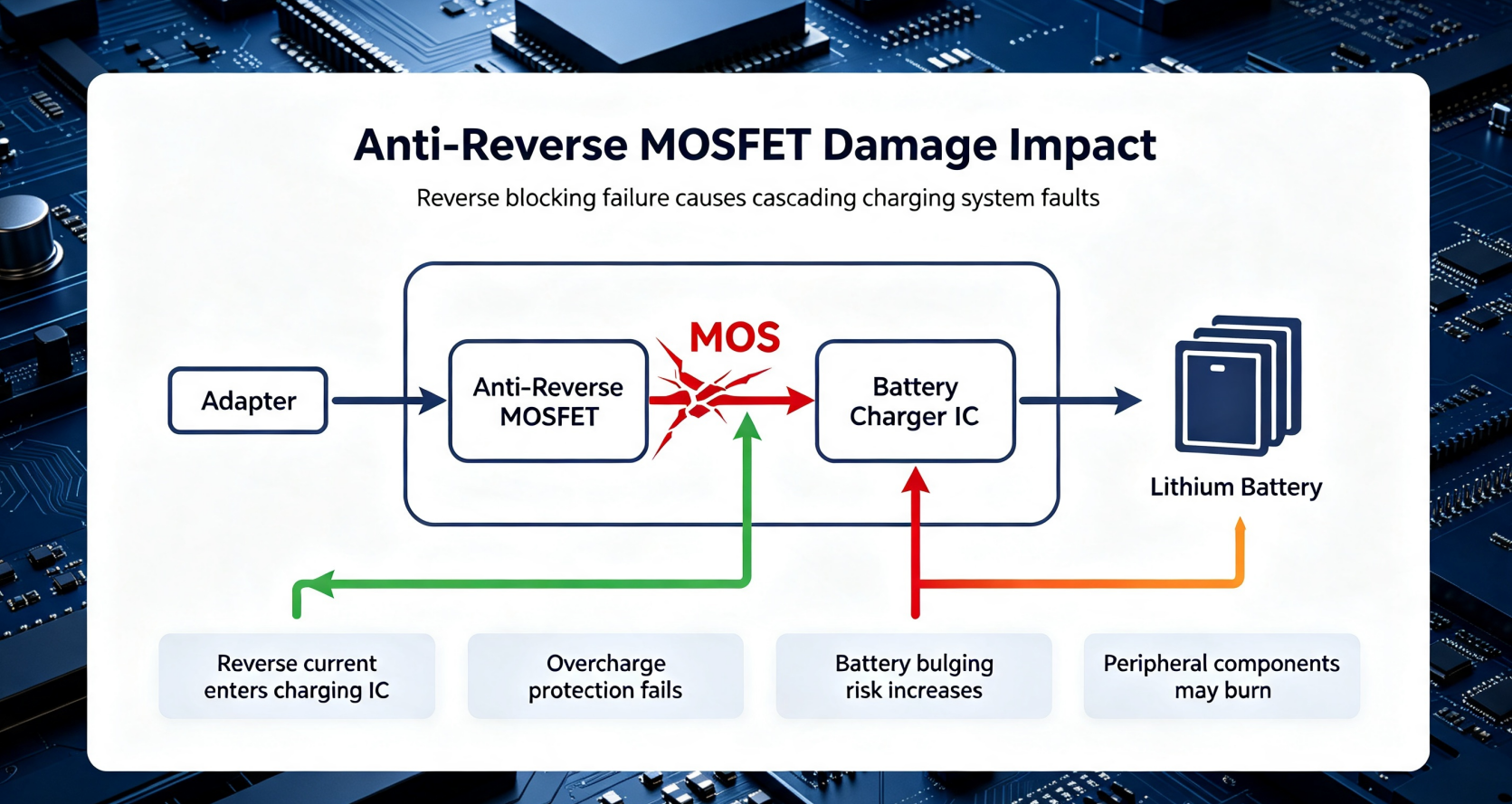
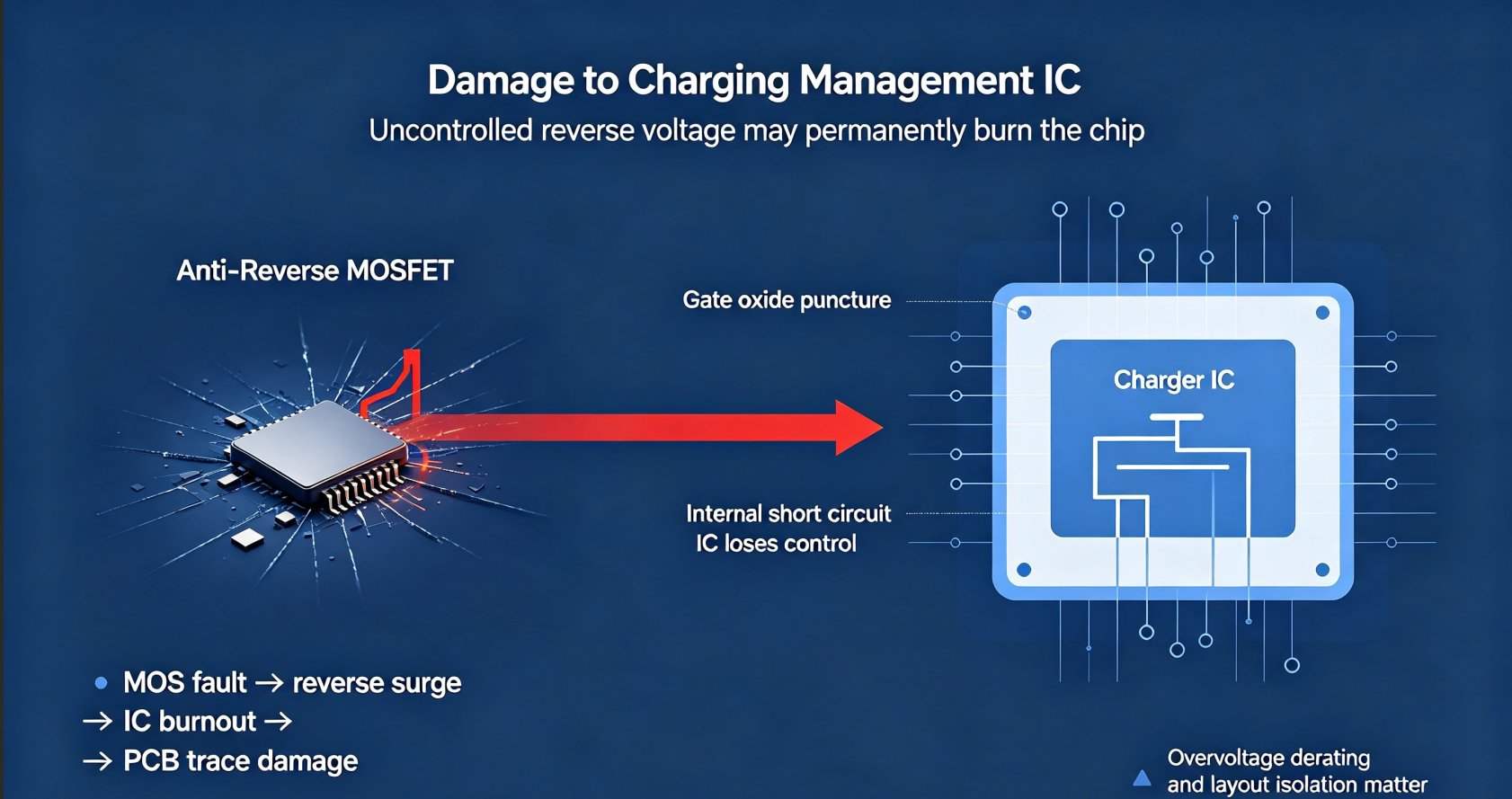
If the anti-reverse MOS suffers short-circuit breakdown between drain and source, reverse voltage and reverse current will directly pour into the pins of the charging management IC without obstruction. The thin gate oxide layer of the internal small-signal transistors inside the chip will be punctured instantly.
Consequences include the charger IC losing control function, internal circuit short-circuit, and permanent burnout of the chip. In severe cases, PCB copper traces will burn open due to excessive short-circuit current.
3. Battery Safety Hazards
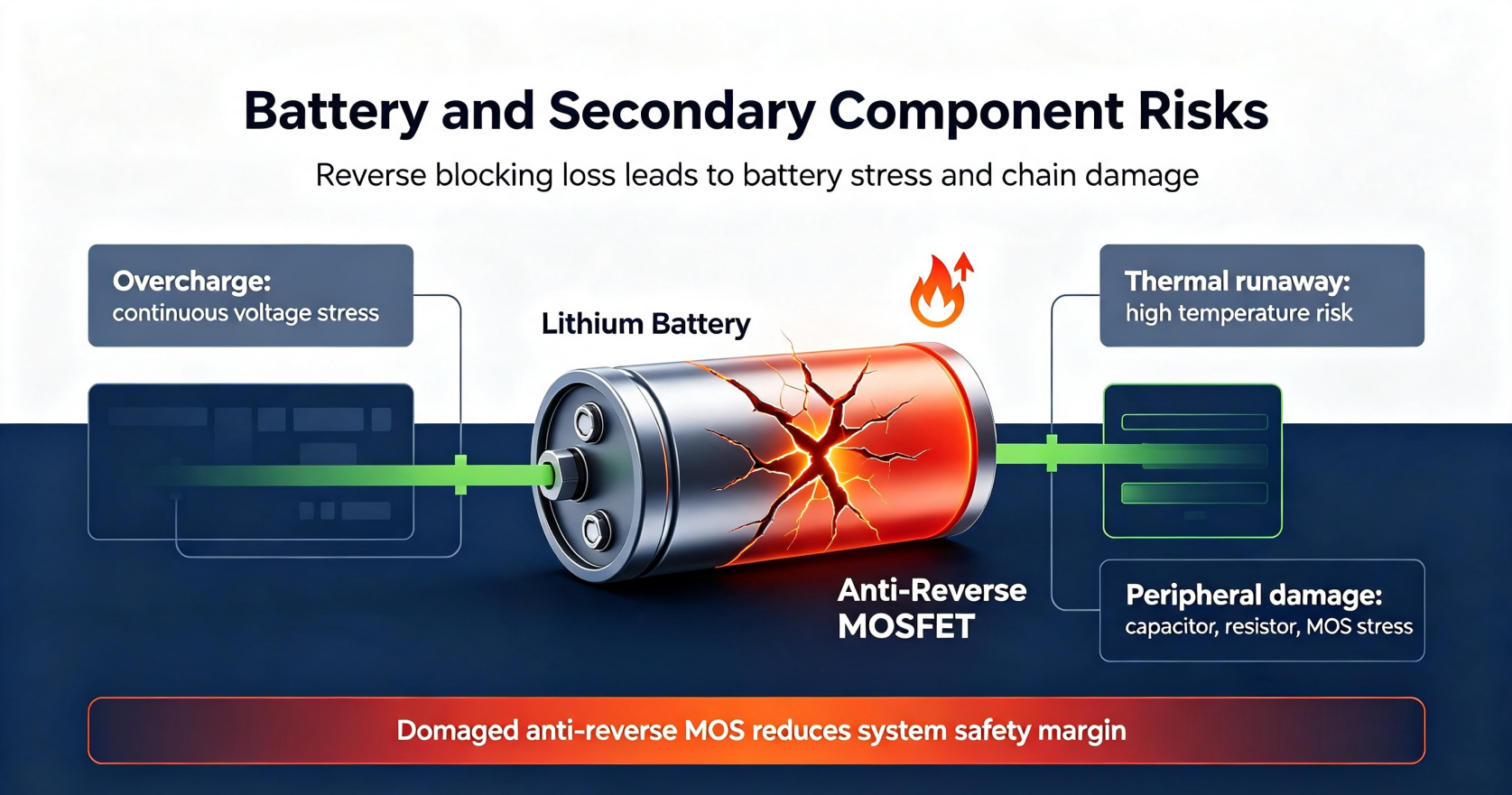
When the anti-reverse MOS fails open-circuit, the reverse blocking function disappears completely:
- If the adapter is inserted with reversed positive and negative poles, large reverse current flows into the lithium battery. Inside the battery, chemical side reactions occur rapidly, generating a great deal of heat, which leads to cell bulging, liquid leakage, or even thermal runaway and fire.
- When the battery is fully charged and the voltage rises, residual surge current flows back to the power supply end continuously, accelerating aging of the battery cells and drastically shortening the service life of the whole battery pack.
4. Malfunction of Charging & Discharging Logic
Short-circuited anti-reverse MOS cannot cut off the charging path normally:
- The system fails to stop charging after the battery reaches full voltage, resulting in continuous overcharging of lithium cells. Long-term overcharging reduces battery capacity and triggers safety risks.
- The circuit loses reverse polarity identification ability. The equipment cannot judge whether the adapter is connected correctly, showing abnormal charging states such as no charging, intermittent charging, or flashing charging indicator lights.
If the anti-reverse MOS is open-circuit damaged, the charging path is permanently disconnected. The equipment cannot charge the battery at all even with a normal adapter plugged in.
5. Secondary Damage to Peripheral Components
Unsuppressed reverse surge current will impact all surrounding passive components on the charging loop:
- Small resistors for current sampling get overheated and burnt; filter capacitors bear reverse voltage, causing swelling and capacity attenuation.
- Parallel synchronous rectifier MOS, secondary power supply auxiliary MOS also face breakdown risks under reverse voltage impact, forming a chain of component damage.
6. Hidden Reliability Problems for Mass Production Products
For finished chargers, power banks, and electric tool battery packs with damaged anti-reverse MOS:
- Products fail safety standard tests for reverse plugging, failing factory quality inspection.
- After-sales failure rate rises sharply, bringing high after-sales maintenance and replacement costs.
- In worst cases, safety accidents such as equipment smoking and fire occur during customer use, leading to product recall risks.
7. Summary of Core Consequences
- Permanent burnout of charging control IC and surrounding peripheral devices;
- Lithium battery overcharge, bulging, leakage and thermal runaway safety risks;
- Abnormal charging, intermittent charging or complete inability to charge;
- Elimination of reverse polarity protection function, zero tolerance for wrong adapter insertion;
- Higher product failure rate and potential safety accident liabilities.


-

Common Gate MOSFET Amplifier: A Comprehensive A...
-
Enabling High Power Applications: Winsok Mosfet...
-

Best Places to Source Quality MOSFET Transistor...
-

MOSFET gate source protection
-

The three pins of a MOSFET, how can I tell them...
-
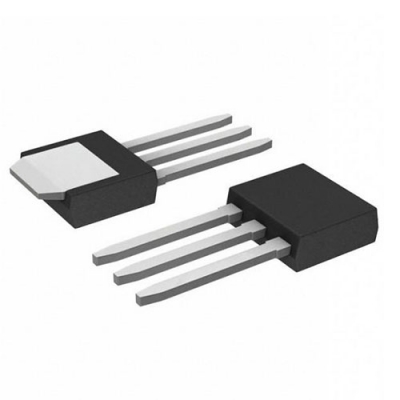
Large Package MOSFET Driver Circuit
-

Conduction Conditions of NMOS Transistors
-

Installing a MOSFET in Your Airsoft Gun: Step-b...
-

Guidelines for MOSFET Package Selection
-

De rol van vermogens-MOSFET-apparaten
-

What Is MCU in Electronics: The Brain Behind Sm...
-

Ultimate Guide to MOSFET Power Amplifiers: Unde...
-

Why are MOSFETs voltage controlled?
-

Testing MOSFETs on PCBs: Field Testing Methods ...
-

CMS8H1213 MCU Cmsemicon® Package SSOP24 Batch 24+
-

DIY MOSFET RF Amplifier Design: A Comprehensive...


