


1. Introduction
Traditional power switches adopt silicon-based MOSFET. In recent years, SiC MOSFET has been widely used in high-voltage, high-frequency scenarios such as EV chargers, energy storage, solar inverters and high-power BLDC controllers.
Many designers are confused about how to select Si MOS or SiC MOS. This article systematically compares their merits and drawbacks, and gives application boundary suggestions.
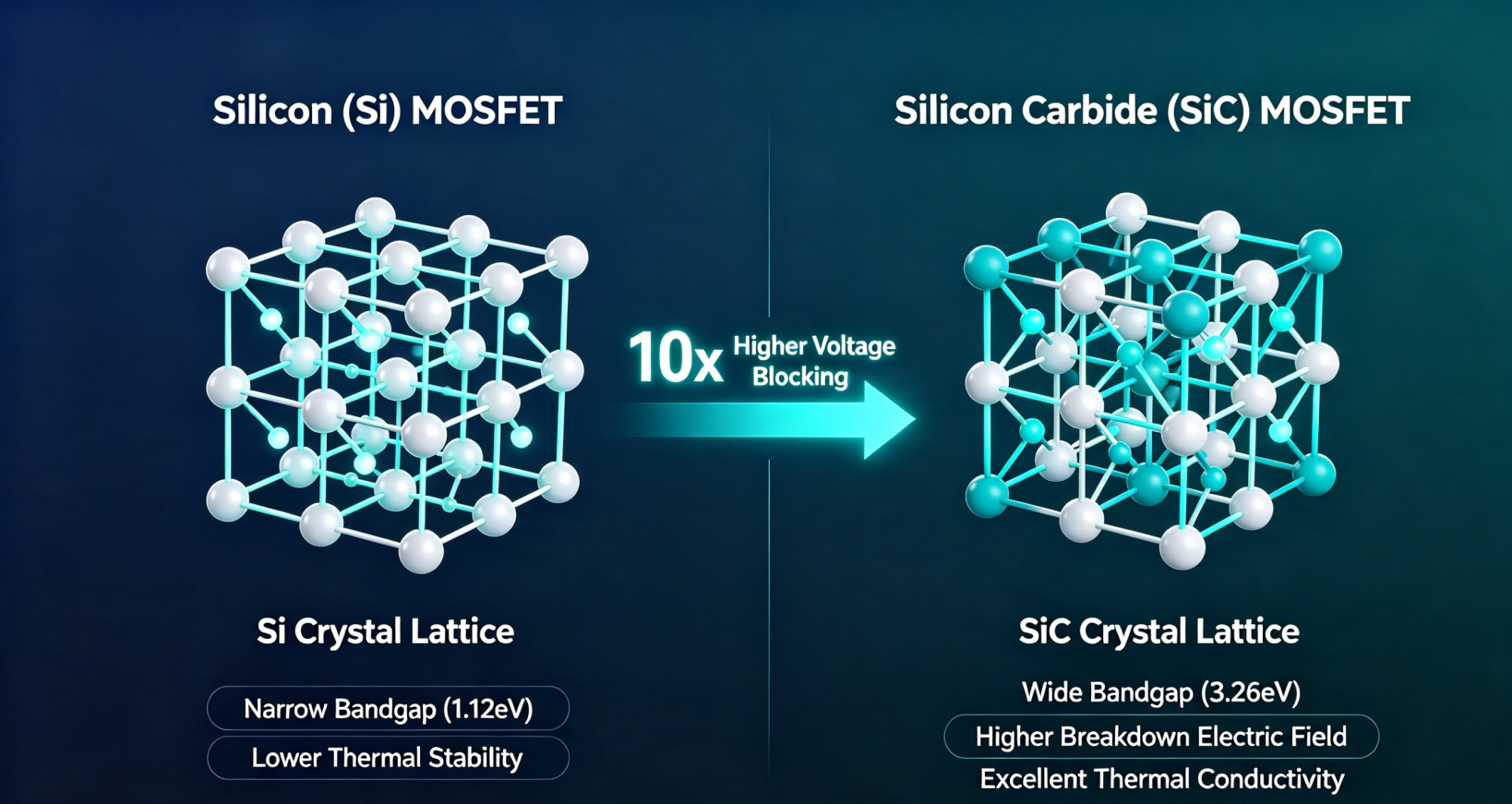
2. Basic Parameter Comparison Overview
Silicon MOSFET (Si MOS, including your Winsok silicon power MOS)
Advantages
- Mature manufacturing process, stable supply chain, competitive unit price
- Simple drive requirement: standard 0V~10V gate driving circuit, no complex auxiliary power supply
- Good short-circuit robustness; easier circuit protection design
- Rich package options: SO-8, DPAK, IPAK, TO252, TO220 for low & medium voltage (20V~200V)
- Low requirement for PCB layout; low sensitivity to gate ringing and EMI
- Ideal for low-voltage BLDC motor, battery management, small DC-DC power supply
Disadvantages
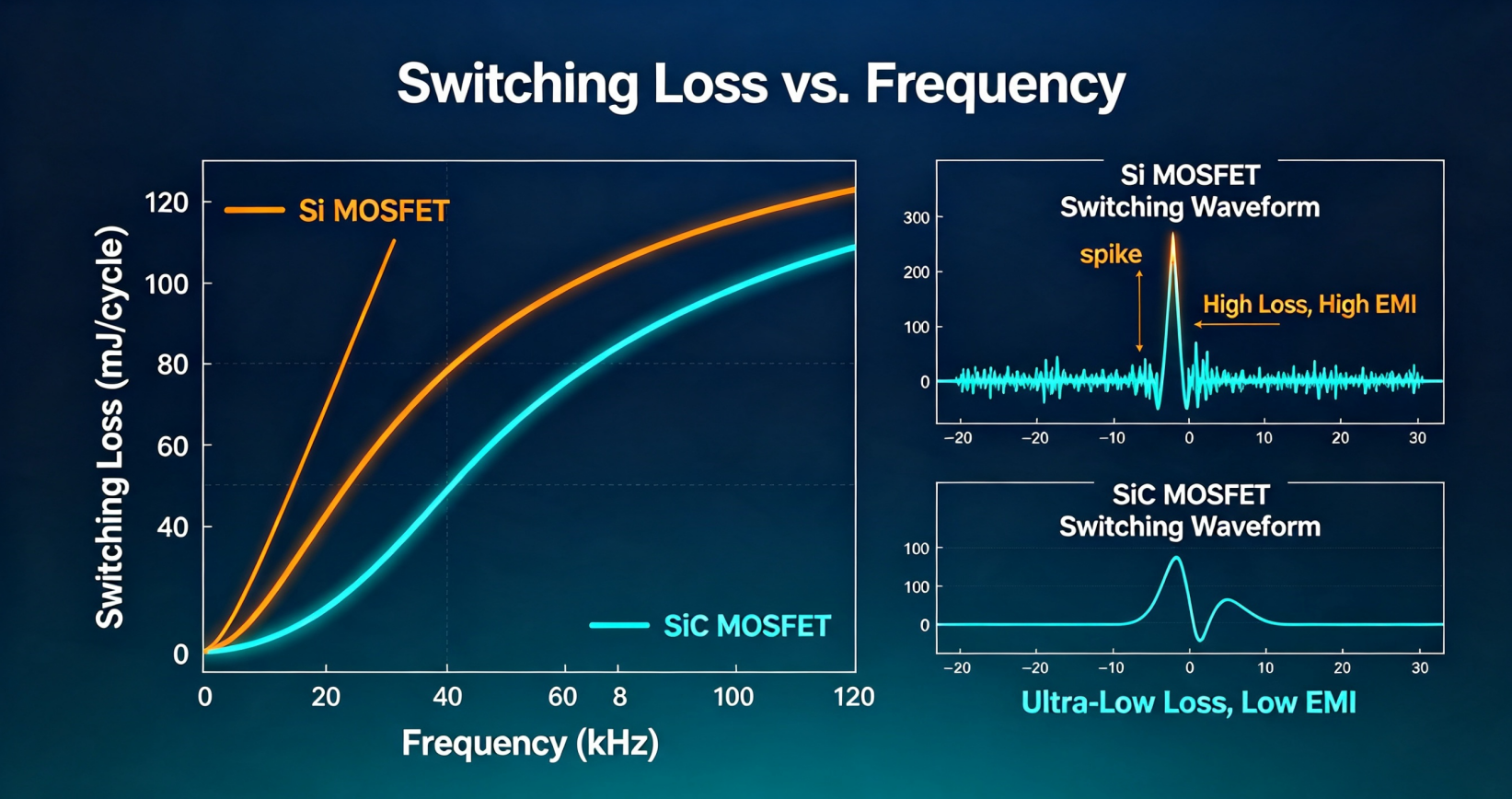
- High switching loss under high frequency; limited maximum operating frequency
- Poor high-temperature performance: RDS(on) rises obviously with temperature
- High reverse recovery loss of body diode
- Voltage grade limitation: high-performance silicon MOS rarely exceeds 300V; ultra-high voltage model loss is huge
- Cannot support high-frequency high-voltage topologies efficiently
Silicon Carbide MOSFET (SiC MOS)
Advantages
- Wide bandgap material, withstand higher junction temperature
- Extremely low switching loss, support hundreds of kHz high-frequency operation
- Smaller parasitic capacitance, greatly reduce EMI in high-frequency circuits
- High voltage specifications mainstream: 650V / 1200V / 1700V, fit energy storage, photovoltaic, on-board charger
- Low conduction loss under high temperature; system can use smaller heat sink
- No obvious reverse recovery current, improve circuit efficiency
Disadvantages
- High raw material & wafer cost, much more expensive than silicon MOS
- Strict gate drive demand: usually need -5V ~ +15V driving voltage. Single positive 10V drive cannot work stably
- Sensitive to gate overvoltage, spike easily causes gate oxide damage
- Poor short-circuit withstand time; requires fast response protection circuit
- Supply volatility; lead time is longer compared with mature silicon devices
- Not cost-effective for low voltage (<200V) applications
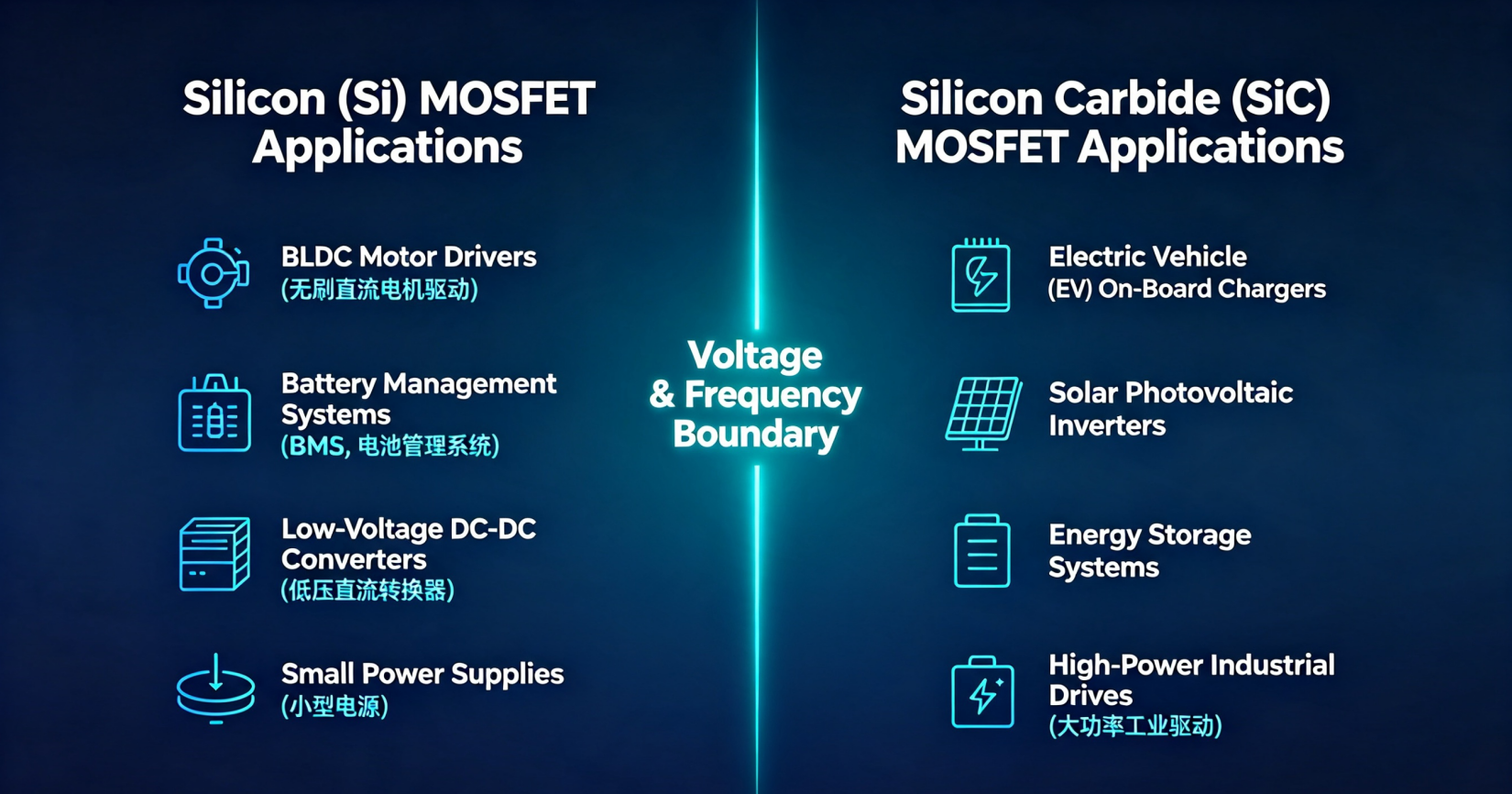
3. Suitable Application Scenarios
Choose Silicon MOSFET (Si MOS)
- Low/medium voltage: 20V ~ 150V
- BLDC motor driver, small household inverters, BMS, low voltage DC-DC
- Cost-sensitive mass production projects
- Working frequency below 100kHz
Choose SiC MOSFET
- Voltage ≥600V
- High frequency topology (solar inverter, energy storage, EV OBC)
- Products pursuing ultra-high conversion efficiency
- Equipment that requires miniaturization (reduce heatsink size)
4. Engineering Summary
Silicon MOS is the cost-effective solution for low & medium voltage BLDC, power adapters and battery management systems. Winsok focuses on silicon power MOS series, which match perfectly with China Micro MCU for motor drive solutions.
SiC MOS gains advantages on high-voltage high-frequency occasions. It is not a universal substitute for silicon MOS. If the working voltage is below 200V, blindly using SiC will significantly raise BOM cost without obvious performance improvement.


-
What are the causes of inverter MOSFET heating?
-
The connection between MOSFETs and Field Effect...
-

How to Use N-Channel MOSFET: An Implementation ...
-

Working with MOSFETs: Essential Knowledge for E...
-

MOSFET overcurrent protection circuit to avoid ...
-

What Happens If You Use Too‑Large Gate Resistor...
-

Special Circuit Design for Power Amplifiers Usi...
-

Stacking MOSFETs for Enhanced Gain: Advanced De...
-

Guidelines for MOSFET Package Selection
-

What is Darlington Emitter Follower? A Comprehe...
-

What is PMOSFET, do you know?
-

FET DFN2X2 package single P-channel 20V-40V mod...
-

What is MOSFET in Electronics: Definition, Work...
-
MOSFET original basic knowledge and application
-

MOSFET Failure Analysis: Understanding, Prevent...


